Blog / AI
When a mixing console gets an MCP server
4 min readMihnea Cojocaru
- AI
- Engineering
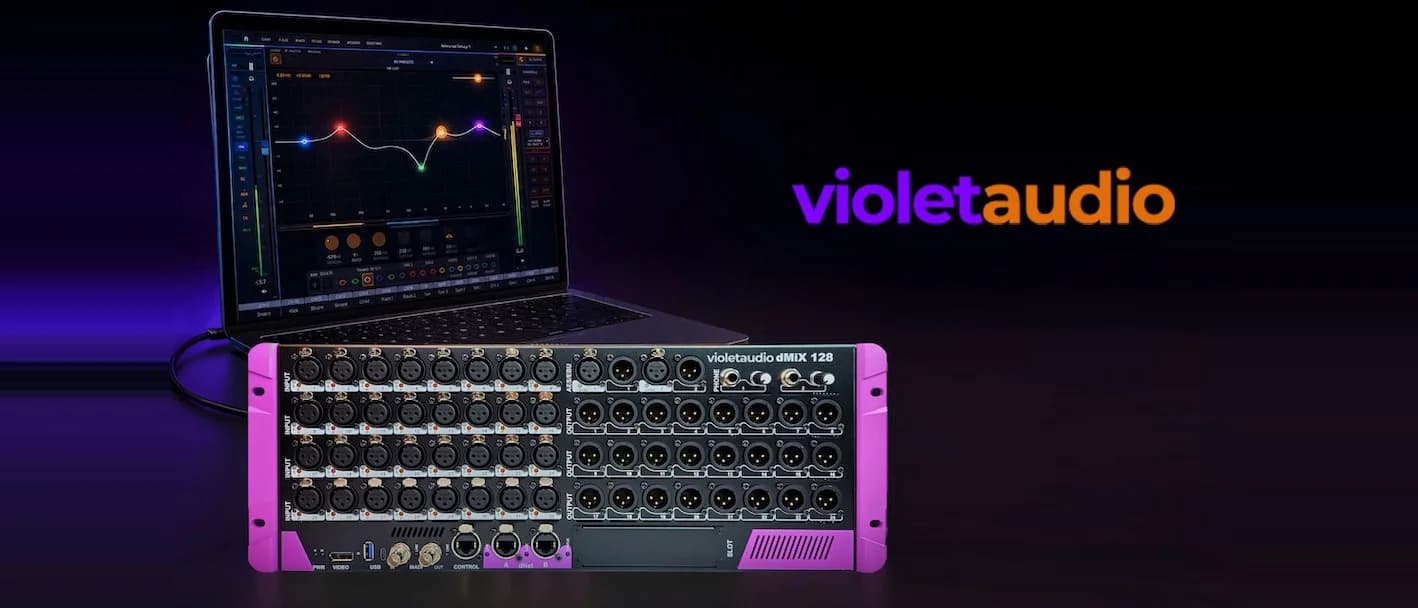
Violet Audio is adding an MCP server to the dMix 128. More interesting to me than the product news is what it says about where professional audio systems are heading.
When I read that Violet Audio is adding a built-in MCP server to its dMix 128, what caught my attention was less the product news itself than what it says about where professional audio systems are heading.
Mixing consoles are less and less thought of as self-contained audio devices. They are becoming networked systems with interfaces, APIs, automation and external control. And that is exactly where it gets really interesting for me.
From mixing console to integrated system
The dMix 128 already supports technologies such as:
- OSC
- browser-based control
- QRC/JSON
- AES67
- SMPTE ST 2110-30
- NMOS
- MADI
- CoreAudio / ASIO
MCP now adds another interface.
The difference is interesting: instead of talking to the system only through classic control commands or custom-built interfaces, a compatible AI client can trigger actions from requests phrased in natural language.
Examples Violet Audio mentions include:
- muting a microphone
- raising a channel by 2 dB
- recalling a snapshot
- identifying channels that are clipping
- preparing routing for a broadcast
- setting up a virtual soundcheck
- running several steps of a workflow together
The audio processing itself stays in the console. MCP serves as the interface between the system and an external application.
Why I find this more interesting than “AI in the mixing console”
At first glance, it would be easy to turn this into a headline:
“Now my AI can run the mixing console.”
Technically, though, I find something else more interesting.
It is about system integration.
Today, a professional audio system often has to talk to several worlds at once:
Audio → network → control → software → automation
This is not really a new problem.
Systems could already be automated via OSC, REST APIs, proprietary protocols or control systems.
But MCP adds an extra layer of abstraction.
An application no longer has to offer just a fixed button with a fixed command. A higher-level system can understand context and derive suitable actions from it.
That can open up new ways of operating a system.
An example
Take an event room.
Traditionally, a control panel might have buttons like:
- Start event
- Presentation
- Break
- Start streaming
- Reset room
Each button triggers predefined actions.
With an MCP-capable system, a request could in theory look more like this:
Set up the room for a hybrid presentation with two wireless microphones, a presentation laptop and streaming.
The system would have to derive several technical actions from that.
For example:
Enable inputs → set routing → configure levels → prepare streaming paths → load snapshot
It is exactly this link between an abstract request and concrete technical actions that I find exciting.
This reminds me a lot of software development
In my work as a developer I deal with interfaces a lot. One system has data or functions. Another system wants to access them. In between, you need clearly defined communication.
In web applications, for example, it looks like this:
Frontend → API → backend → external service
Professional AV systems are increasingly starting to look similar:
User interface → automation → network → audio device
The technologies are different. The underlying problem is very similar.
Systems need to know:
- which functions are available
- which parameters are expected
- what the current state is
- what an action changes
- whether the action succeeded
That is one of the reasons why I find what is happening around AV over IP, control systems and open interfaces so interesting right now.
At the same time, new questions come up
Of course, natural-language control does not automatically mean you should give an AI system unrestricted control over an entire production.
Especially with live, broadcast or installed systems, predictability and operational reliability are crucial.
That is why questions like these become interesting:
- Which actions is an AI client allowed to perform at all?
- Which commands need confirmation?
- Which states may the system change?
- What happens with ambiguous requests?
- How are permissions handled?
- How is it logged which action was performed?
- Which functions deliberately stay with the operator alone?
The more closely AV systems are tied into IT infrastructure, the more important these questions become.
Professional audio systems are turning into IT systems
To me, the dMix 128 mainly shows a development that has been visible for a while anyway.
Professional audio is moving more and more towards:
- Ethernet
- Audio-over-IP
- APIs
- central control
- browser interfaces
- automation
- standardised protocols
- software integration
A modern audio engineer does not suddenly have to become a software developer. But the line between audio, network and software is getting thinner. And it is exactly that line I find most exciting. After years in sound engineering and my work as a software developer today, these two fields feel less and less like separate worlds to me.
Maybe they are growing back together right now.
Mihnea Cojocaru
Full-stack developer | sound engineer in Bonn with high standards for clean engineering and good usability.